What time does it get dark in Seoul in December? Plan sightseeing
Table of Contents
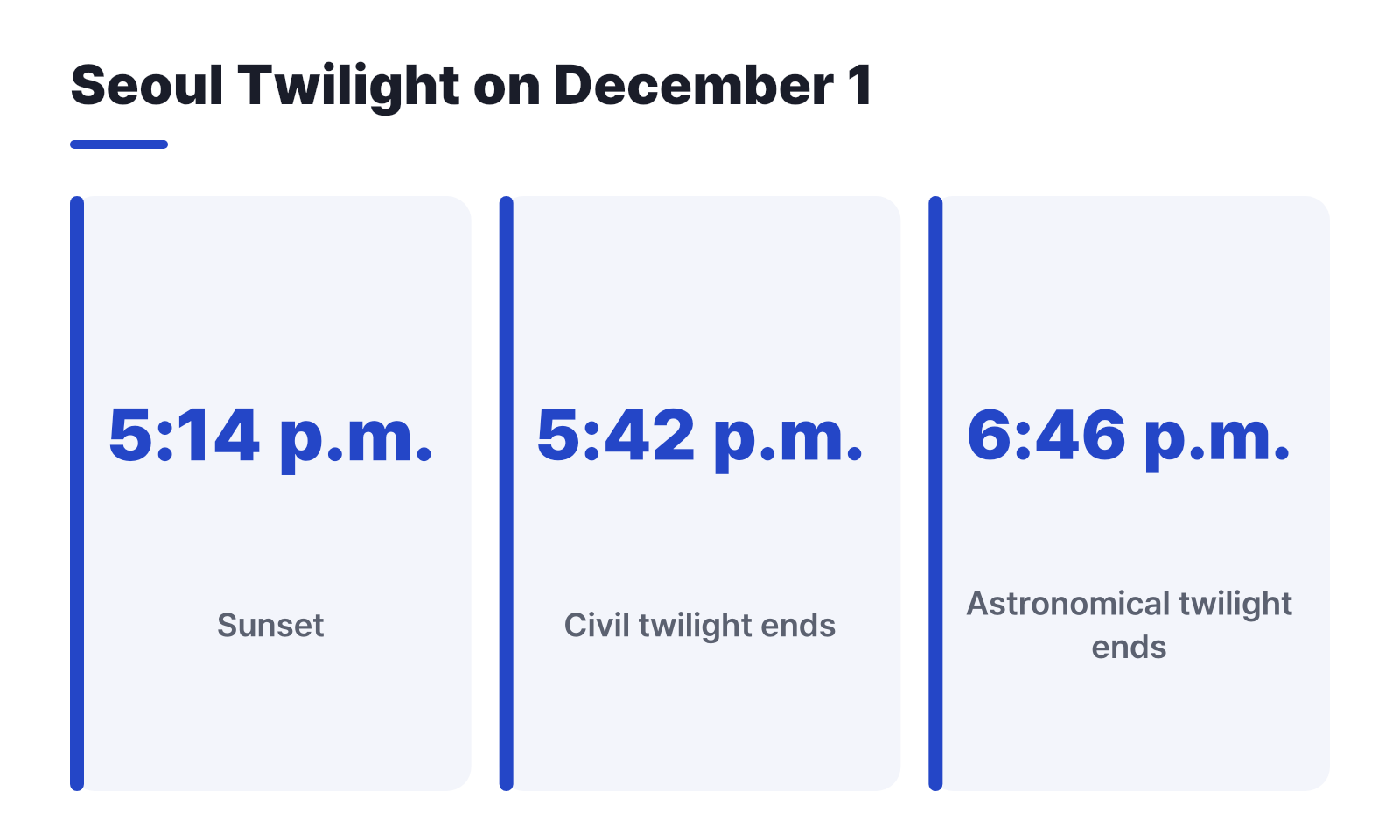
In Seoul, sunset in December 2026 falls between 5:13 and 5:23 p.m. KST, depending on the date. The sky stays in civil twilight for a while after sunset: on December 1, civil twilight ends at 5:42 p.m., so plan outdoor sightseeing for daylight and save illuminated streets or indoor stops for later.
| Date in December 2026 | Sunset | End of civil twilight | Useful planning window |
|---|---|---|---|
| December 1 | 5:14 p.m. | 5:42 p.m. | Outdoor plans before sunset; twilight photos afterward |
| December 15 | 5:14 p.m. | Not listed here | Finish daylight-dependent visits by late afternoon |
| December 22 | 5:17 p.m. | Not listed here | Keep outdoor visits earlier in the day |
| December 31 | 5:23 p.m. | 5:52 p.m. | Allow a daylight buffer before the evening plan |
The date-specific times come from the 2026 Seoul sunrise-and-sunset table on timeanddate.com. All times are local Korean Standard Time (KST). The table compares four dates so you can see the small shift across the month; it does not mean every attraction follows the same schedule.
What time does it get dark in Seoul in December?
For a practical sightseeing plan, treat sunset as the point when direct sunlight disappears and the end of civil twilight as the later point when the sky has lost most of its usable natural light. On December 1, that means sunset at 5:14 p.m. and civil twilight ending at 5:42 p.m.; astronomical twilight continues until 6:46 p.m.
“Dark” can mean different things for a traveler. At sunset, the sun has dropped below the horizon, but twilight remains. Civil twilight is the brighter twilight phase; after it ends, artificial lighting is needed outdoors. Astronomical twilight lasts longer, but that later time is not a useful target for ordinary sightseeing photos or walking around without street lighting.
In the 2026 table, the sun sets at 5:14 p.m. on December 1 and 5:23 p.m. on December 31. The end of civil twilight shifts from 5:42 p.m. to 5:52 p.m. across those dates. The difference is modest, so a late-month arrival does not create an extra hour for outdoor plans.
For the exact date of your visit, use the date rather than a general December average. Sunset times change day by day, and a few minutes can matter if you are trying to catch the last daylight at a viewpoint or finish an outdoor visit before dusk.
How should you compare early-, mid-, and late-December sightseeing?
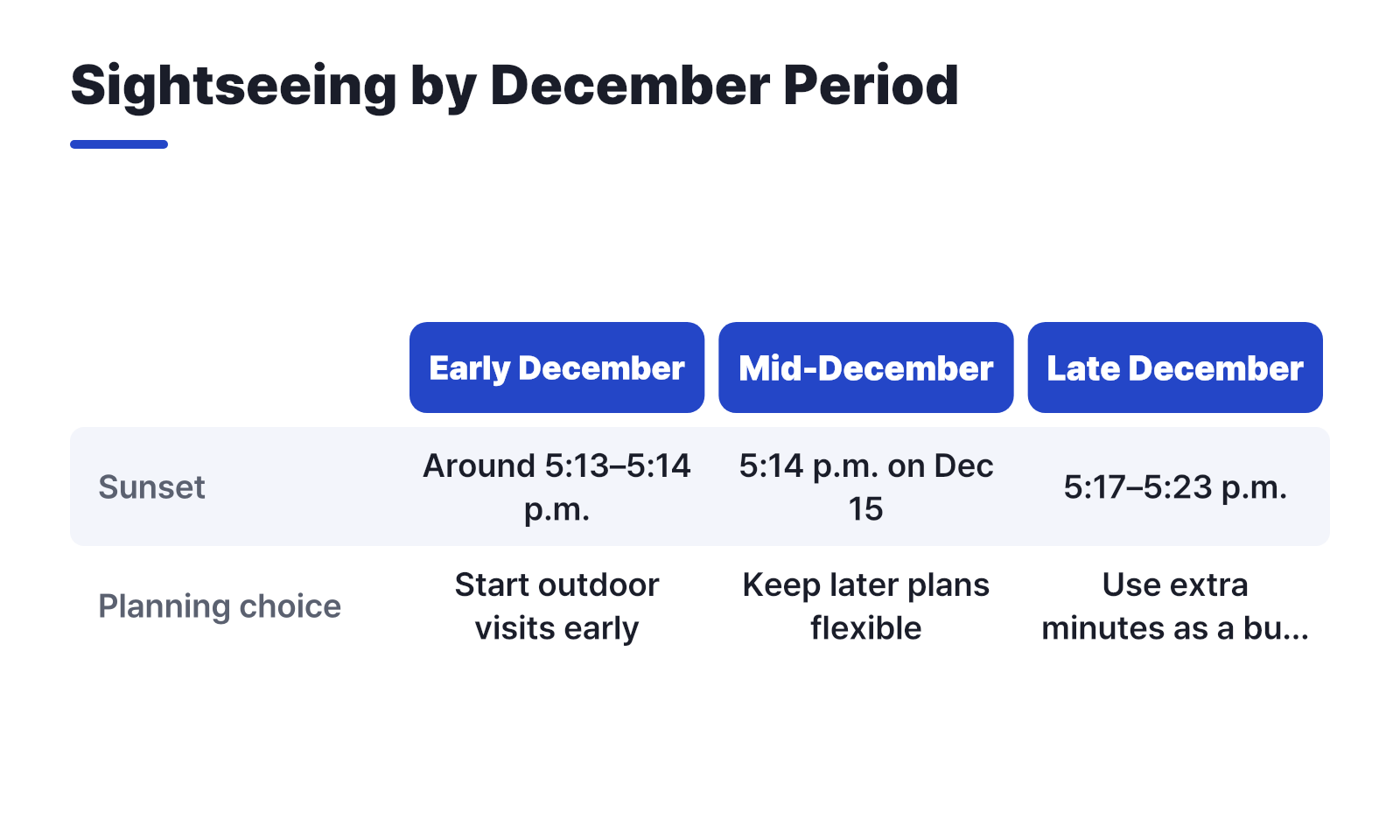
Early December has the earliest sunset in this sample, while late December offers several more minutes of evening daylight. For all four dates, the practical choice is the same: put your most daylight-dependent activity earlier, then schedule a flexible meal, indoor stop, or evening walk after sunset.
Seoul has about 9 hours and 38 minutes of daylight on average in December, based on the monthly figures for the city. That short winter day makes a packed outdoor itinerary harder to stretch into the evening. The comparison below is about daylight, not attraction opening hours or travel time.
| Visit period | What the daylight timing means | Planning choice |
|---|---|---|
| First days of December | Sunset is around 5:13–5:14 p.m.; December 1 civil twilight ends at 5:42 p.m. | Start outdoor sightseeing early and avoid making sunset the start time for a long visit. |
| Middle of December | Sunset is 5:14 p.m. on December 15 in the 2026 table. | Use the morning and early afternoon for outdoor stops; keep the later block flexible. |
| Late December | Sunset moves to 5:17 p.m. on December 22 and 5:23 p.m. on December 31. | Use the extra minutes as a small buffer, not as a reason to add another distant outdoor stop. |
If you are deciding between two outdoor stops, choose the one that needs daylight for the earlier slot. The later stop can be a place where evening lighting is part of the visit, provided its hours and access work for your date.
How can you plan a Seoul sightseeing day around sunset?
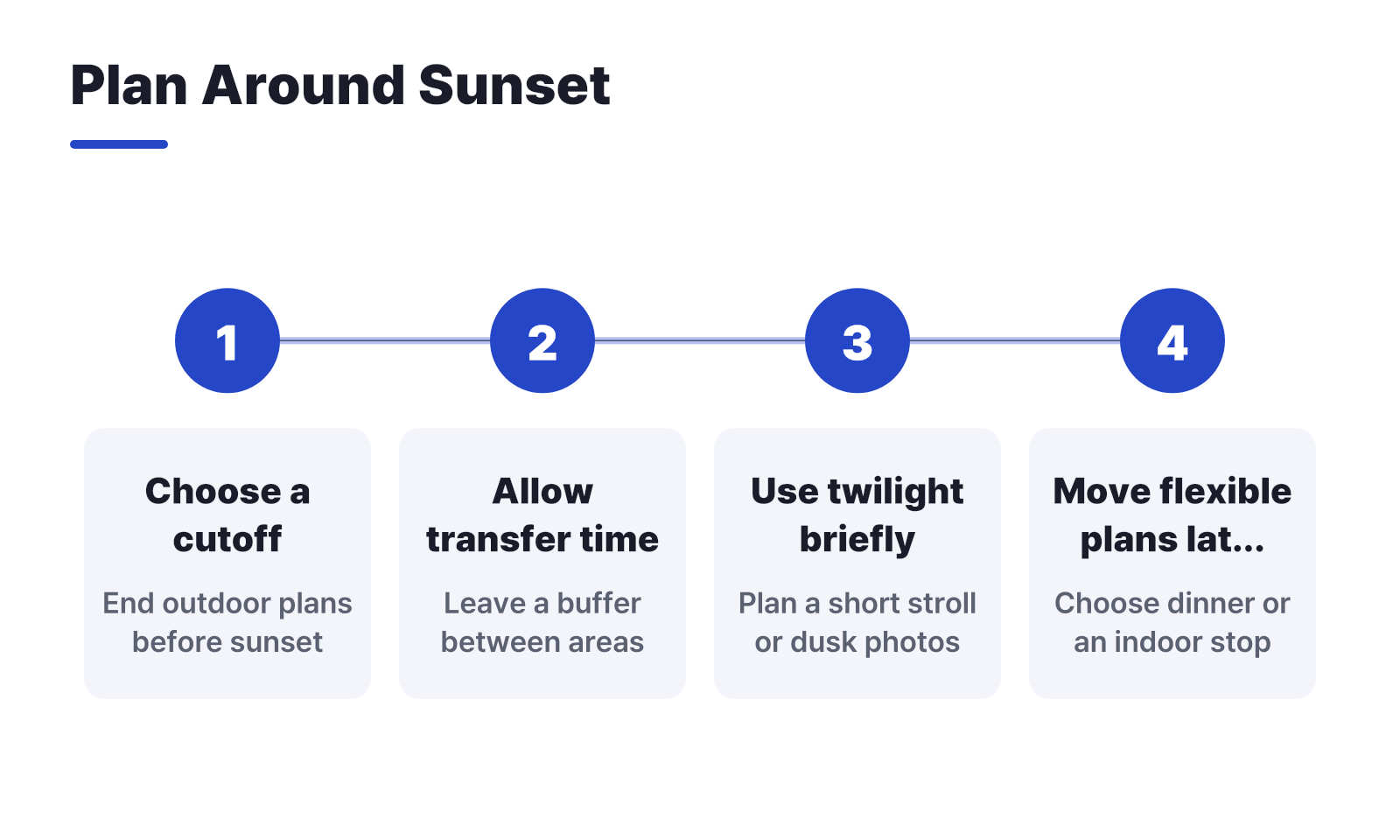
Build the day backward from sunset: set a firm end time for the outdoor activity, leave a buffer for moving to the next area, and use the evening for a stop that does not depend on daylight. For a December 1 schedule, use 5:14 p.m. as sunset and 5:42 p.m. as the end of civil twilight.
- Put the daylight-dependent visit first. Schedule a palace, park, outdoor market, or viewpoint during the morning or early afternoon if daylight is part of the experience. The exact opening and closing hours depend on the place, so confirm them for your visit date.
- Set a personal outdoor cutoff. Choose a time before sunset to leave the main attraction. That gives you room for walking or transit without relying on the final minutes of daylight.
- Use twilight as a short transition. From sunset until civil twilight ends, the sky is not yet at its darkest. This period can work for a brief outdoor stroll or dusk photos, but do not mistake it for a full extra sightseeing block.
- Move the flexible activity to evening. Plan dinner, an indoor attraction, or a well-lit area after dusk. Check the destination’s own hours before building the schedule around it.
For example, a simple December 1 outline is an outdoor visit before mid-afternoon, a short transfer and break before 5:14 p.m., then an evening activity after dusk. This is a timing framework rather than a promise about how long a particular palace, market, or museum takes to visit.
Keep nearby activities together when possible. The sunset table gives the daylight window, but it does not tell you how long a cross-city trip will take or whether a particular attraction is open. A plan with one main outdoor area is easier to adjust than several far-apart stops scheduled close to sunset.
What should you prepare for a December evening?
Plan for a winter evening and for the possibility that weather changes the appeal of an outdoor stop. The available December travel guidance describes Seoul as cold and notes that snow can occur; it does not provide a dependable forecast for your specific travel date.
Pack a warm outer layer and shoes that feel secure for walking, then keep an indoor alternative in mind for the final part of the day. If rain or snow makes an outdoor plan uncomfortable, shifting that stop earlier or replacing it with an indoor visit keeps the schedule from depending on clear skies.
For photos, decide whether you want the sunset itself, the brighter twilight sky, or a fully dark city scene. On December 1, those are different windows: sunset is at 5:14 p.m., civil twilight ends at 5:42 p.m., and astronomical twilight ends at 6:46 p.m. The last time describes the end of astronomical twilight, not a guarantee that a city view will look completely dark or that a site remains open.
Recheck the sunset and twilight times for your exact date, then confirm attraction hours separately. If an outdoor site closes before the time you planned, move it earlier rather than relying on the twilight period.
Wrap-up
For December 2026, Seoul sunset runs from about 5:13 p.m. early in the month to 5:23 p.m. on December 31. Choose your date’s sunset time, place the daylight-dependent stop earlier in the day, and reserve the evening for an activity that works after dark.
References
- Sunrise and sunset in South Korea
- Korea Weather in December 2026: Seoul, Busan and Jeju Temperatures, Snow Odds, Winter Festa, Christmas and New
- Sunrise and sunset times in Seoul, December 2026
Information in this post was checked as of November 2026. Policies and prices may change, so please verify important details with official sources.


Comments
Post a Comment